
The small, strange
world of lichens.
A fungus and an alga living as one, on the tree trunks, walls and gravestones you walk past. A field guide to 54 species, with every fact traced to its source.
A fungus and an alga living as one, on the tree trunks, walls and gravestones you walk past. A field guide to 54 species, with every fact traced to its source.

In 2005 ESA strapped two lichens, map lichen and elegant sunburst, to the outside of the Foton-M2 capsule. Back on Earth they started photosynthesising again.
Elegant Sunburst Lichen Rusavskia elegans → Source: European Space Agency, BIOPAN-5Map lichen spreads across granite slower than almost anything alive. Geologists use its width to date rockfalls and glacier retreats.
Map Lichen Rhizocarpon geographicum → Source: Armstrong & Bradwell (2010), Geografiska AnnalerReindeer lichen, dug out from under the snow. It takes decades to grow back after a herd has grazed it down.
Reindeer Lichen Cladonia rangiferina → Source: US Geological Survey, caribou winter dietFossil lichens from the Lower Devonian of the Welsh Borderland, fungus and algal cells still together in the tissue.
British Soldiers Cladonia cristatella → Source: Honegger, Edwards & Axe (2013), New PhytologistAlmost all made by the fungal partner. Many exist nowhere else, which is why a drop of bleach can turn one lichen red and leave its look-alike grey.
Wolf Lichen Letharia vulpina → Source: Bracegirdle et al. (2025), Scientific DataA lichen looks like a single organism: a crust on a rock, a leaf on a branch, a beard hanging from a tree. But look closer. Every lichen is a stable partnership between a fungus and one or more photosynthetic organisms: green algae, cyanobacteria, or both. The fungus builds the body and absorbs water. The photosynthetic partner makes food from sunlight. Together, they create something neither could alone.
For centuries, scientists believed lichens were individual organisms. In 1867, Swiss botanist Simon Schwendener proposed that they were actually a symbiosis, and was rejected by leading lichenologists before being proven right. Then in 2016, researchers found basidiomycete yeasts embedded in the cortex of some lichens, mainly in the shield-lichen family, hinting that a few lichens may be three-way partnerships. Later surveys found the yeasts absent from most lichens, and their role is still unproven.
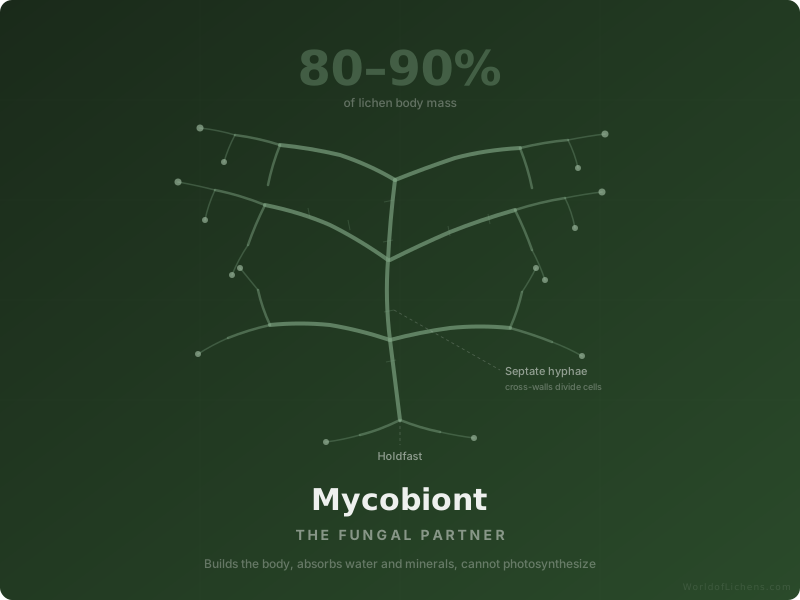
The fungus. Builds the body, absorbs water and minerals. Makes up most of the lichen’s bulk. Cannot photosynthesize.
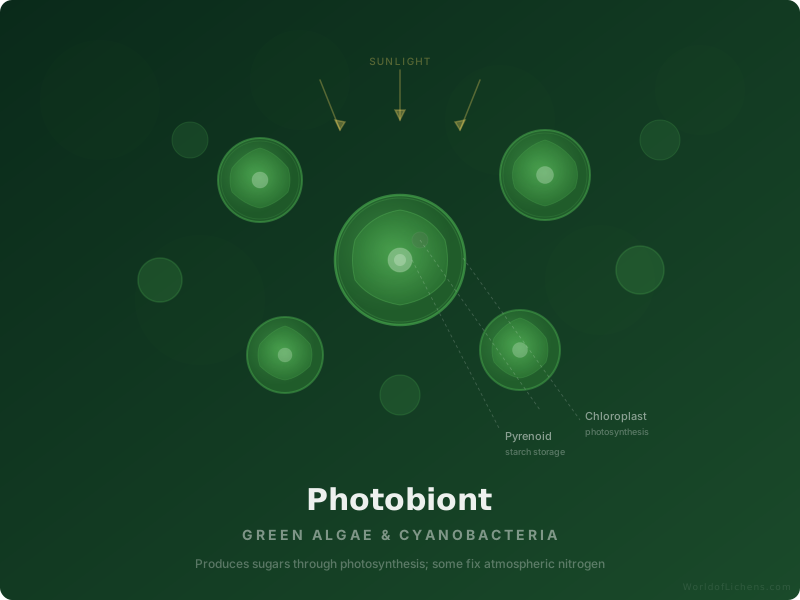
Green algae or cyanobacteria. Produces sugars through photosynthesis. Some fix nitrogen from the atmosphere.
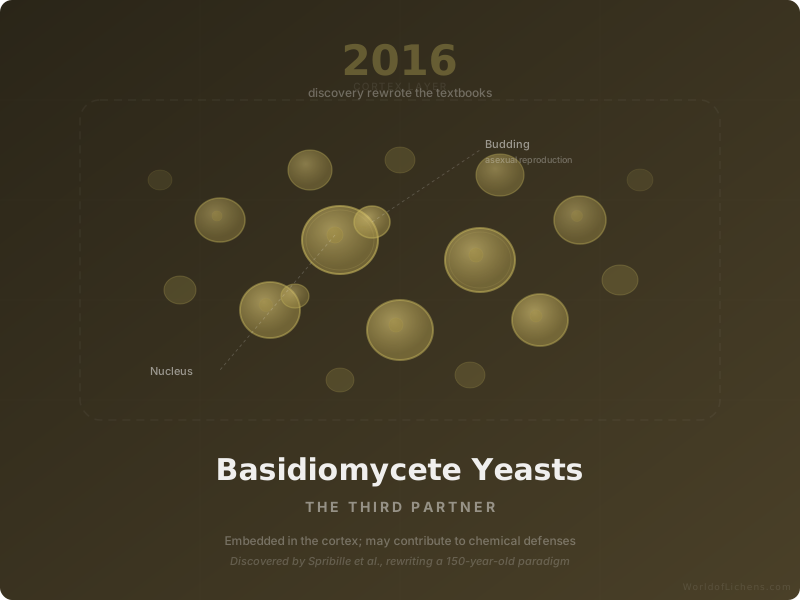
Basidiomycete yeasts found embedded in the cortex of some lichens. A possible third partner; their role is still unproven.
The most common photobiont. Genera like Trebouxia produce sugars efficiently through photosynthesis. Remarkably, the same algae species can partner with many different fungi to create entirely different-looking lichens.
Partners like Nostoc can both photosynthesize and fix atmospheric nitrogen, converting N2 gas into biologically usable forms. This makes cyanolichens important nitrogen suppliers in humid forests and soil crusts, where usable nitrogen is scarce.
Tripartite lichens like Lobaria pulmonaria have it both ways: green algae as the primary photobiont plus cyanobacteria housed in special structures called cephalodia. Efficient sugar production and nitrogen fixation in one organism.
Eight distinct body plans for conquering every surface on Earth. Here are the six you will meet most often.
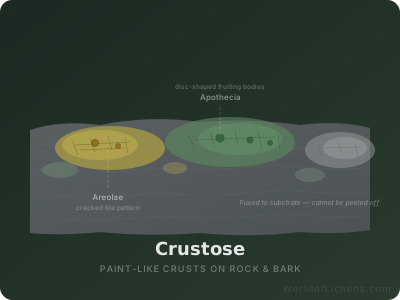
Paint-like crusts fused to rock or bark. Home to some of the oldest living organisms on Earth. Map lichen grows only about 0.1–0.5 mm a year.
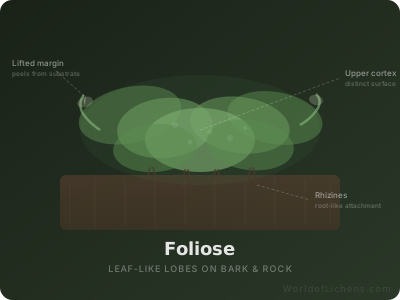
Leafy, with distinct upper and lower surfaces. Attached by root-like rhizines.
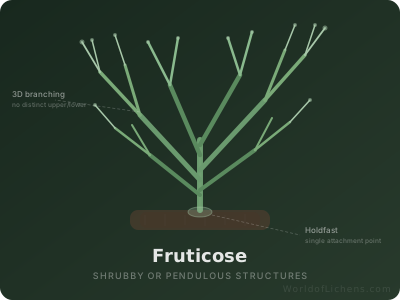
Shrubby or hanging 3D structures. Includes old man's beard, British soldiers, and reindeer lichen. Generally the most pollution-sensitive.
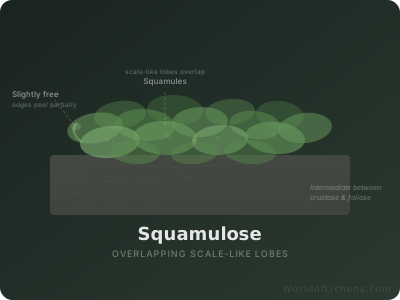
Overlapping scale-like lobes, like shingles on a roof. Intermediate between crustose and foliose.
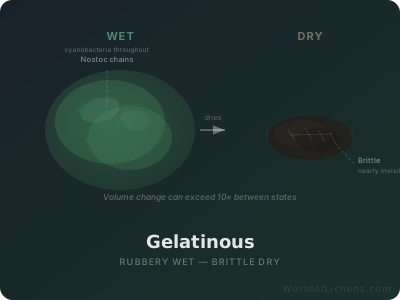
Rubbery when wet, dark and brittle when dry. Cyanobacterial partner. Dramatically changes appearance with moisture.
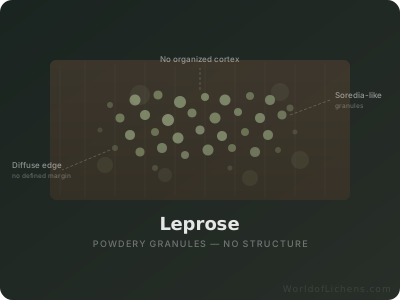
Entirely powdery and granular with no organized structure. Like a dusting of colored powder on bark.
Lichens are the ultimate pioneer species. They colonize bare rock, volcanic lava, and lifeless surfaces, then slowly, over centuries, transform them into soil. Five mechanisms work together: physical cracking, chemical weathering with oxalic acid, organic decomposition, particle entrapment, and nitrogen fixation by cyanolichens.
In Pacific Northwest old-growth forests, cyanolichens contribute typically about 2–5 kg of nitrogen per hectare per year, and up to about 16 kg in very lichen-rich stands. On bare rock, lichens are often among the first links in the chain of succession that ends in forest.
In 2005, lichens survived 14.6 days of direct exposure to the vacuum of space outside an uncrewed Russian Foton-M2 capsule, in the European Space Agency’s BIOPAN-5 experiment — then resumed photosynthesis back on Earth.
Six chapters covering everything from cellular anatomy to field identification.
Symbiosis, cross-section anatomy, eight growth forms, and how lichens reproduce their dual partnership.
02Pioneer species, five mechanisms of soil building, ecological succession, and why lichens make such good pollution monitors.
03Profiles of 54 species organized by growth form: from common greenshield to old man's beard to map lichen.
04Dyes, food, medicine, perfumery, space survival, lichens estimated at thousands of years old, and caribou that depend on lichen for survival.
05Visual ID steps, chemical spot tests (K, C, KC, P, UV), a dichotomous approach, and a complete glossary of terms.
06A comprehensive dictionary of lichenology terms, from apical to veins, with clear definitions for every concept in this guide.


