Chapter Two
Ecology & Air Quality
The first organisms to colonize bare rock, lichens build soil from nothing, drive ecological succession,
and serve as the planet's most sensitive living pollution monitors.
The Ultimate Pioneer
When a glacier retreats, a volcano cools, or a rockfall exposes fresh stone, life faces an impossible
puzzle: how do you colonize a surface with no soil, no water retention, and no nutrients? The answer,
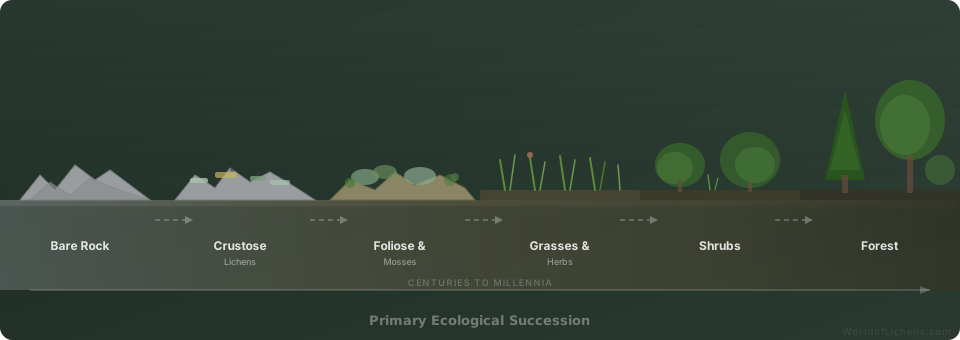
almost always, is lichens. They are among the very first organisms to establish on bare rock, fresh lava flows,
and other lifeless surfaces, beginning the multi-century process of transforming stone into soil.
Because they absorb water and minerals directly from the air and rain, lichens need nothing from the
substrate beneath them except a place to hold on. No roots. No soil. No pre-existing organic matter.
This makes them unrivaled as pioneer species: the first link in the chain of
ecological succession that eventually leads from bare rock to forest.
“Without lichens, the chain of succession from bare rock to forest could not begin.
They are the architects who lay the foundation for all terrestrial life that follows.”
Five Mechanisms of Soil Building
Lichen-driven soil formation is not a single process but a coordinated assault on rock by five
simultaneous mechanisms. Physical force, chemical dissolution, biological decomposition, passive
entrapment, and atmospheric chemistry all work together across centuries to create the first
pockets of soil on otherwise lifeless stone.
Physical Biodeterioration
Fungal rhizines grow into microscopic cracks in rock, anchoring the lichen while physically
widening fissures. As the thallus absorbs water, it expands by up to 300% of its dry volume,
then shrinks back as it desiccates. This relentless wetting-drying cycle pries rock apart grain by grain.
Water held in the newly widened cracks freezes in winter and expands further, amplifying the effect.
Over centuries, this mechanical weathering fragments solid rock into loose mineral particles.
Chemical Weathering
Lichens are chemical factories. They secrete oxalic acid, which dissolves calcium
in limestone and attacks other minerals. Carbonic acid, produced through respiration, dissolves calcium
carbonate. Over 800 unique secondary lichen compounds contribute additional corrosive effects.
Through chelation, lichen chemicals bind and extract metal ions from rock minerals,
and they can convert feldspar to clay minerals, effectively manufacturing soil-grade particles
from solid stone.
Organic Decomposition
As lichens grow, senesce, and die, their biomass becomes organic matter. In productive ecosystems,
this can amount to 1,020 kg of organic matter per hectare, over a metric ton
of humus-building material. The remains of crustose lichens become embedded directly in the rock
surface, creating a layer of dark, nutrient-rich humus that provides the first foothold for mosses
and eventually plant roots.
Particle Entrapment
The rough, textured surface of lichen thalli acts as a passive filter for wind-blown particles.
Dust, pollen, mineral grains, and organic debris all become trapped in the irregular surface of
the lichen body. These particles mix with decomposing lichen tissue to form proto-soil,
the first mineral-organic mixture in what will eventually become a true soil horizon.
Nitrogen Fixation
Bare rock contains essentially zero biologically available nitrogen, the element most critical for
plant growth. Cyanolichens (those partnered with cyanobacteria such as
Nostoc) solve this problem by converting atmospheric N2 gas
into usable ammonia and nitrates. Species like Peltigera,
Lobaria, Collema, and Leptogium
are major fixers. In Pacific Northwest old-growth forests, cyanolichens contribute
2–5 kg of nitrogen per hectare per year, fertilizing the entire ecosystem from the canopy down.
Why nitrogen fixation matters: Some lichens have cyanobacteria housed in
specialized structures called cephalodia, devoted entirely to nitrogen fixation.
These tripartite lichens (fungus + green alga + cyanobacteria) get the best of both worlds:
efficient sugar production from the alga and atmospheric nitrogen from the cyanobacteria.
Substrates & Habitats
Lichens are classified not just by their growth form but by what they grow on. Each substrate type
presents unique challenges (pH, moisture, texture, stability), and lichens have
specialized to exploit them all.
| Substrate Type |
Definition |
Characteristics |
Example Genera |
| Saxicolous |
Growing on rock |
Preference for calcareous (limestone) vs. siliceous (granite) rock; surface pH and mineral content determine which species thrive |
Rhizocarpon, Xanthoria |
| Corticolous |
Growing on bark |
The most common epiphytic lichens; bark pH, texture, and moisture retention are key factors; acidic bark (conifers) vs. basic bark (elm, ash) host different communities |
Parmelia, Usnea, Lobaria |
| Terricolous |
Growing on soil |
Common in tundra, heathland, and open ground; often forms extensive mats; critical winter forage for caribou |
Cladonia, Peltigera |
| Lignicolous |
Growing on wood |
Dead wood, fence posts, and decorticated timber; wood pH and decay stage affect colonization |
Cladonia, Lecanora |
| Foliicolous |
Growing on leaves |
Almost exclusively tropical; colonize long-lived evergreen leaves in humid forests; must complete life cycle before the leaf falls |
Strigula, Porina |
Living Pollution Monitors
Lichens have no roots, no stomata, and no waxy cuticle. They absorb everything directly from the air
and rainwater, which makes them extraordinarily sensitive to atmospheric chemistry. They cannot shed
damaged parts the way a tree drops leaves; pollutants accumulate in their tissues over decades.
This combination of total exposure and permanent accumulation makes lichens the world's most reliable
bioindicators of air quality.
The principle is elegantly simple: different lichen species have different pollution tolerances.
When sensitive species vanish and tolerant species dominate, the air has changed. The absence of
lichens entirely (a "lichen desert") signals severe pollution.
The Nitrogen Spectrum
Lichen communities tell a clear story about nitrogen levels. The dominant species shift predictably
from clean to polluted environments.
Clean Air
Nitrogen-sensitive oligotrophs dominate. Look for Usnea (beard lichens),
Evernia prunastri (oakmoss), and Hypogymnia physodes (hooded tube lichen).
Large fruticose and foliose species with complex structures.
Moderate
Intermediate species persist. Parmelia sulcata (hammered shield),
Melanelixia (camouflage lichen), and Flavoparmelia caperata
(common greenshield) tolerate moderate nitrogen levels.
Nitrogen-Enriched
Nitrophiles dominate. Xanthoria parietina (orange lichen),
Physcia spp. (rosette lichen), and Lecidella elaeochroma
indicate high nitrogen from agriculture or urban sources.
OPAL Air Survey: Nine Indicator Species
The UK's Open Air Laboratories (OPAL) program identified nine key lichen species for citizen science
air quality monitoring. These nine species span the nitrogen sensitivity spectrum, making it possible
to assess local air quality by simply recording which are present and which are absent.
Practical interpretation: If your survey finds mostly Xanthoria,
Physcia, and Candelaria, the area likely has high nitrogen from
agricultural or urban runoff. Abundant Usnea, Lobaria, and
Bryoria indicate clean air. No lichens at all points to severe pollution or a very
recently disturbed surface.
N−
Nitrogen-Sensitive (Clean Air Indicators)
Usnea spp. (beard lichens, fruticose) •
Evernia prunastri (oakmoss, antler-like branching) •
Hypogymnia physodes (hooded tube lichen, inflated lobes)
N~
Intermediate
Parmelia sulcata (hammered shield, network of ridges) •
Melanelixia spp. (camouflage lichen, brown-green with isidia) •
Flavoparmelia caperata (common greenshield, wrinkled yellow-green)
N+
Nitrogen-Loving (Enrichment Indicators)
Xanthoria parietina (common orange lichen, foliose) •
Physcia spp. (rosette lichen, gray with white below) •
Lecidella elaeochroma (crustose, gray-green with dark discs)
Cyanolichens in Pacific Northwest old-growth forests contribute 2–5 kg of nitrogen per hectare per year,
fertilizing the entire ecosystem from the canopy down, without a single grain of synthetic fertilizer.