From field observations and hand-lens work to chemical spot tests and lab chromatography, a systematic approach to putting a name on the lichen in front of you.
With roughly 20,000 described species worldwide, lichen identification is both deeply rewarding and genuinely challenging. Many species look nearly identical to the naked eye but differ in their chemistry. Others change appearance dramatically between wet and dry conditions. A systematic approach (combining visual observation, chemical tests, and sometimes lab work) is essential for reliable identification.
The process below moves from the simplest observations anyone can make in the field to advanced techniques used by professional lichenologists. You can often narrow a specimen to genus with just the first few steps, but species-level identification frequently requires chemistry.
Before reaching for reagents or a microscope, careful observation with a hand lens (10x) will take you surprisingly far. Work through these eight steps in order for every specimen.
| Step | Observation | Key Questions | Narrows To |
|---|---|---|---|
| 1 | Growth Form | Crustose, foliose, fruticose, squamulose, gelatinous, or leprose? | Major group |
| 2 | Color | Green, gray, yellow, orange, brown, black? Note both wet and dry color. | Order / Family |
| 3 | Substrate | On bark (corticolous), rock (saxicolous), soil (terricolous), or wood (lignicolous)? | Ecological group |
| 4 | Lobe Shape | Broad or narrow lobes? Rounded or pointed tips? Flat or ascending margins? | Genus |
| 5 | Reproduction | Soredia, isidia, apothecia, perithecia, or lobules present? | Species group |
| 6 | Underside | Black, white, brown, or tan? Rhizines simple or branched? Veins visible? | Genus / Species |
| 7 | Special Features | Cilia, pseudocyphellae, cyphellae, tomentum, pruina, or lirellae? | Species |
| 8 | Geography & Habitat | Region, elevation, forest type, microhabitat, exposure? | Confirms ID |
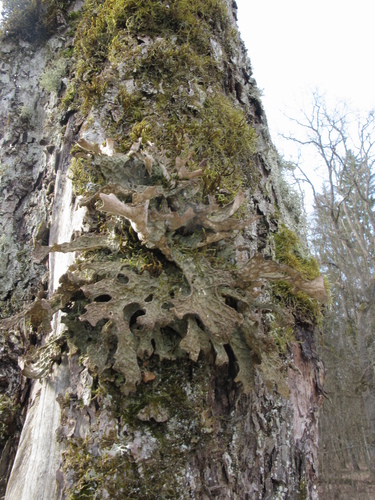
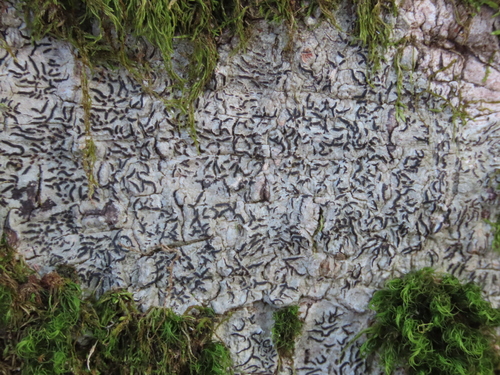
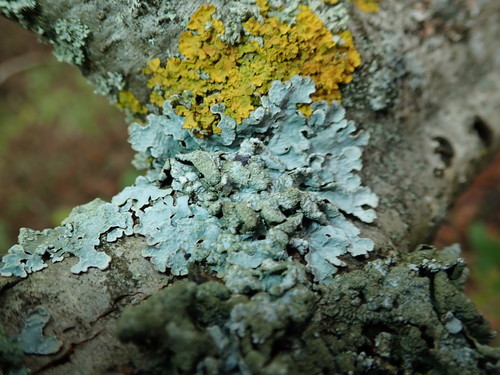
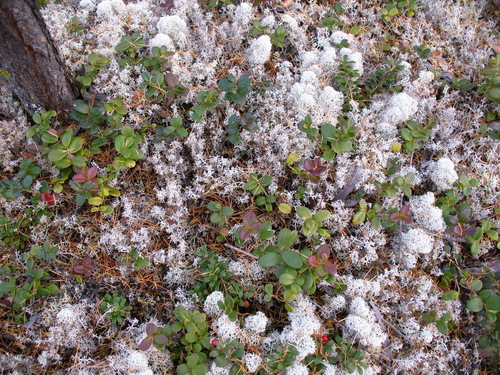
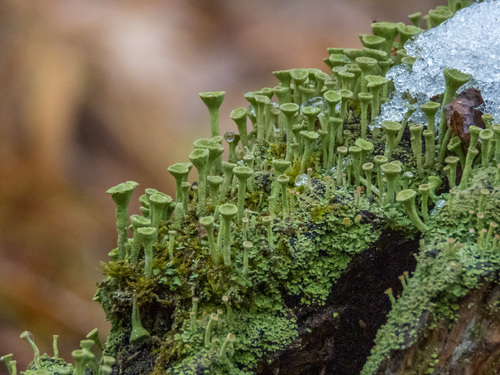
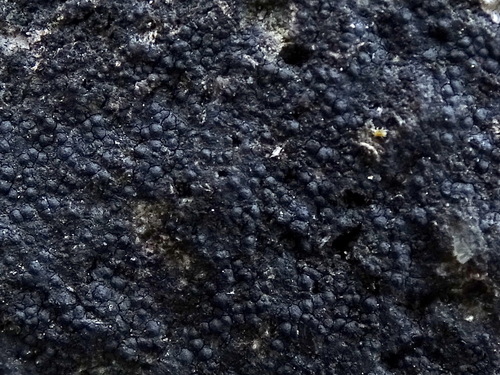
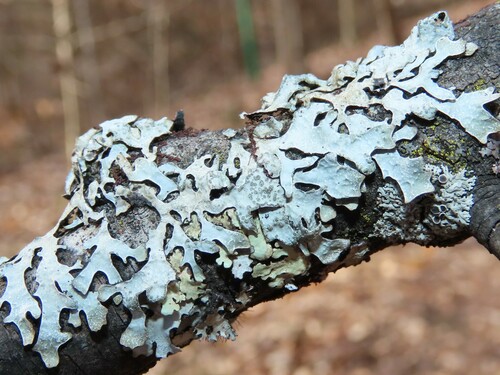
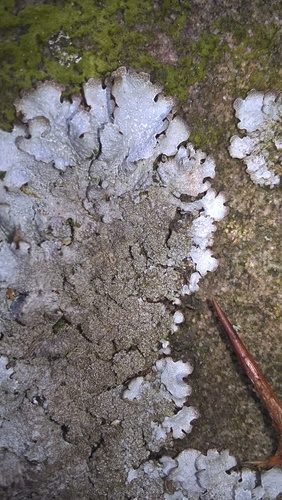
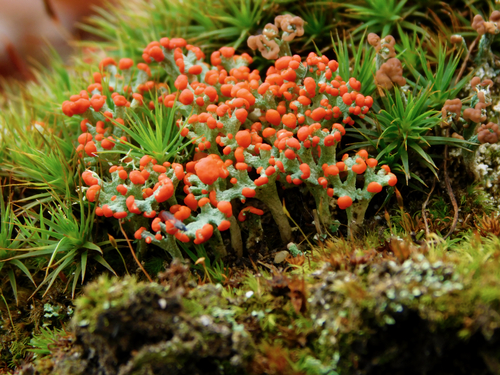
This is always your starting point. Is the lichen a flat crust fused to the surface (crustose), a leafy structure you can peel up at the edges (foliose), a three-dimensional shrubby or hanging form (fruticose), overlapping scales (squamulose), a jelly-like mass (gelatinous), or a powdery dusting with no visible structure (leprose)? Growth form alone eliminates the vast majority of possible species.
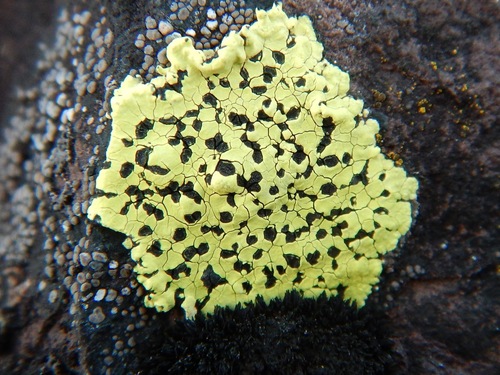
Crustose
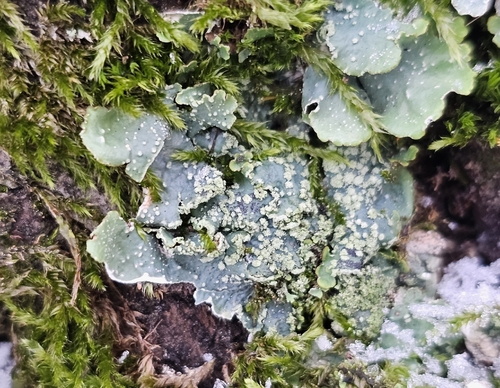
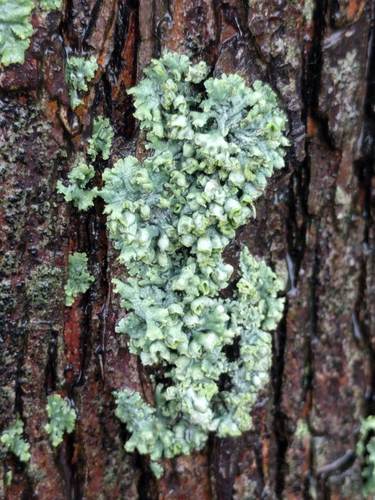
Foliose
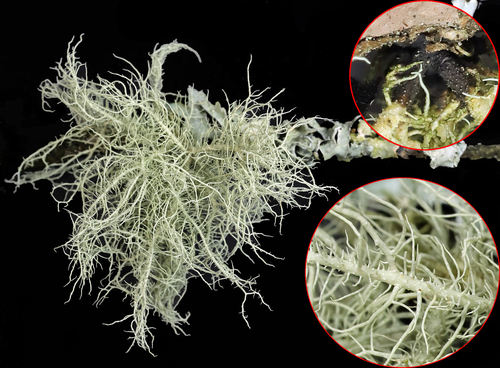
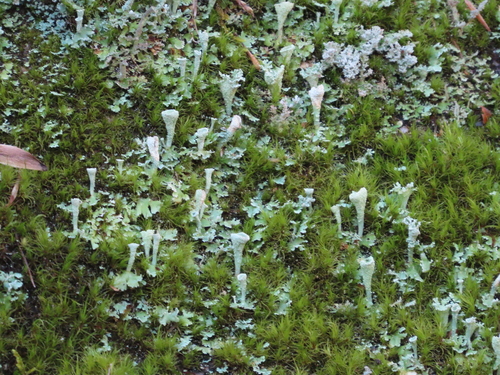
Fruticose
Squamulose
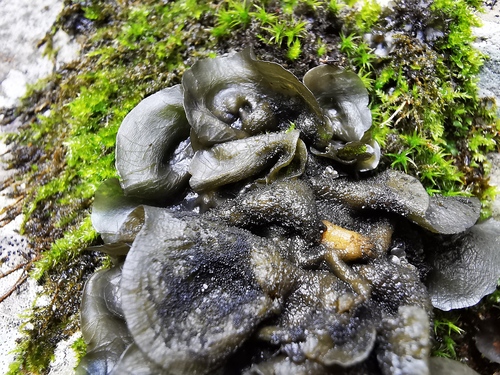
Gelatinous
Leprose / Crustose
Record the color carefully, and note whether the specimen is wet or dry, since many lichens change color dramatically with moisture. Dry gray-green lichens often become vivid green when wet. Bright yellows and oranges usually indicate specific chemical compounds (usnic acid, anthraquinones) that narrow identification immediately.
What the lichen is growing on matters enormously. Many species are strict specialists: Xanthoria parietina favors nutrient-enriched bark and rock, while Rhizocarpon geographicum grows exclusively on siliceous rock. Note the specific tree species if on bark, and rock type (limestone vs. granite) if saxicolous.
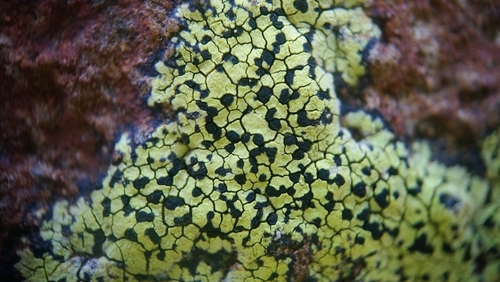
Saxicolous (rock)
Corticolous (bark)
Terricolous (soil)
Lignicolous (wood)
For foliose lichens, lobe morphology is critical. Are lobes broad (over 5 mm) or narrow? Are the tips rounded, truncate, or pointed? Do the margins curl up, lie flat, or curl under? Are the lobes tightly appressed to the substrate or loosely ascending? These details separate genera that look superficially similar.
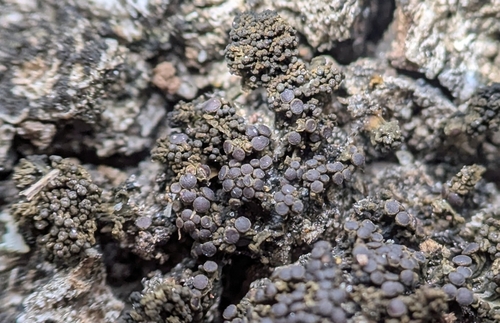
Look for apothecia (open disc-shaped fruiting bodies), perithecia (flask-shaped bodies embedded in the thallus), soredia (powdery granules), isidia (finger-like outgrowths), or lobules (tiny lobe-like propagules). The presence or absence of these structures is one of the most important species-level characters.
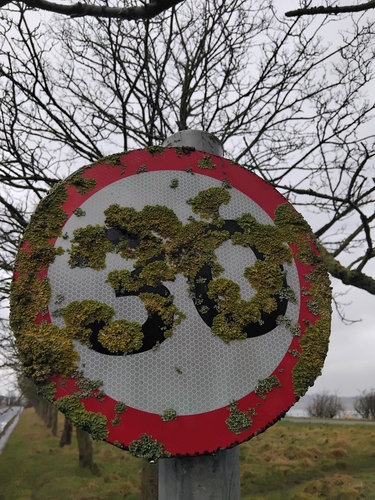
Apothecia
Perithecia
Soredia
Isidia
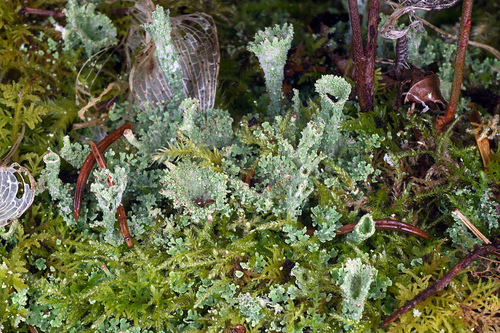
Podetia
Gently lift a lobe edge to examine the lower surface. Is it black, brown, white, or tan? Are there rhizines (root-like attachment structures), and if so, are they simple, squarrose (brush-like), or dichotomously branched? Some genera have distinctive undersurface features: Peltigera has raised veins, and Sticta has round pores called cyphellae.
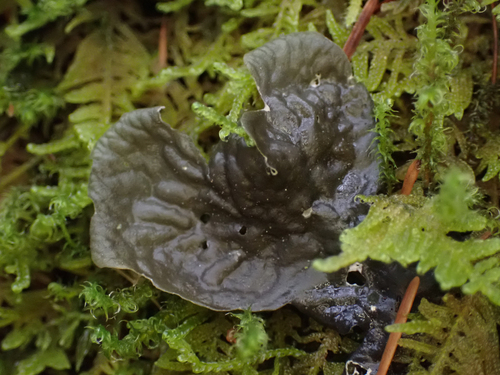
Rhizines & veins (Peltigera)
Cyphellae (Sticta)
Pseudocyphellae (Punctelia)
Look for cilia (hair-like projections from lobe margins), pseudocyphellae (white dots or lines on the upper surface that are pores in the cortex), tomentum (a fuzzy felt-like covering), or pruina (a frosty white coating). These micro-characters often clinch the identification when everything else is ambiguous.
Where you are matters. Many lichens have restricted geographic ranges, and distribution is a valid identification character. Note your region, elevation, forest type (old-growth vs. secondary), aspect (north-facing vs. south-facing), and proximity to pollution sources. A lichen that looks like Lobaria pulmonaria but grows near a highway probably is not — it requires clean air.
Soredia vs. Isidia — The Critical Distinction
Both are asexual reproductive structures, but they differ fundamentally and separating them is one of the most important skills in lichen identification.
Powdery granules erupting from breaks in the cortex (called soralia). Loose bundles of algal cells wrapped in fungal hyphae, with no cortex of their own. Look dusty or granular under a hand lens.
Finger-like, coral-like, or cylindrical outgrowths from the thallus surface. Crucially, they have their own cortex: a smooth, intact outer layer. Look like tiny organized projections, not like dust.
Many species pairs are separated solely by this character. For example, Parmelia sulcata has soredia in its cracks, while Parmelia saxatilis has isidia. They are otherwise nearly identical.
Many lichen species are visually identical but differ in their secondary chemistry. Five reagent tests (each targeting different compound classes) let you distinguish them in the field. Apply reagents to the cortex or scratch through to the medulla, depending on which layer you need to test.
Apply a small drop of 10% KOH solution to the cortex or exposed medulla. Watch for a color change: K+ yellow indicates atranorin; K+ yellow turning red indicates salazinic acid; K+ orange-brown suggests norstictic acid. K− (no reaction) is equally informative. This is the single most useful spot test and the one to learn first.
Apply diluted household bleach to the cortex or medulla. C+ pink or red indicates gyrophoric acid or lecanoric acid. Many lichens are C− (no reaction), which is also a useful data point. The C test is especially important for crustose species where K alone is insufficient.
Apply K first, then immediately apply C to the same spot. The combined reaction may differ from either reagent alone. KC+ pink or red-orange detects alectoronic acid and physodic acid, compounds that are invisible to K or C individually. Always record K and C results separately before testing KC.
Apply P reagent to the medulla (scratch through the cortex first). P+ orange or red indicates fumarprotocetraric acid or protocetraric acid. These are among the most common lichen compounds and P is essential for distinguishing many look-alike species.
Safety warning: Paraphenylenediamine is toxic and a known carcinogen. Always wear gloves and avoid skin contact. Work in a well-ventilated area. Many field lichenologists use P dissolved in ethanol and apply it with a fine brush or cotton swab. Dispose of waste properly.
Some lichen compounds fluoresce under long-wave ultraviolet light. Blue-white, orange, or yellow fluorescence can indicate divaricatic acid, squamatic acid, and other compounds. UV is non-destructive, requires no reagents, and is especially useful in the field after dark. A portable 365 nm UV flashlight is an inexpensive but powerful addition to any lichen toolkit.
When spot tests are ambiguous or you need to identify the exact compound present, thin-layer chromatography is the gold standard. TLC separates individual chemical compounds from a lichen sample and compares them to known standards, giving definitive chemical identification.
A small fragment of lichen is dissolved in acetone or another organic solvent and spotted onto a glass plate coated with silica gel. The plate is placed upright in a developing chamber containing a carefully calibrated solvent system. As the solvent wicks upward by capillary action, different compounds travel at different rates depending on their polarity and molecular weight. The result is a series of separated spots, each representing a single compound.
By comparing the position (Rf value) and color of each spot against known standards run on the same plate, the lichenologist can identify the exact compounds present. This is how the more than 800 known lichen secondary compounds have been catalogued, and it remains the definitive method for chemical identification when spot tests leave doubt.
When to use TLC: TLC is most valuable when two species are morphologically identical and differ only in chemistry, so-called chemical species or chemotypes. It is also essential when publishing new species descriptions, as chemical data is now considered a required component of lichen taxonomy.
These commonly confused species pairs illustrate why careful observation and chemistry matter. Learning to separate them will sharpen your identification skills across the board.
Hammered Shield Lichen
Gray-green foliose lichen with a distinctive network of ridges (reticulate pattern) on the upper surface. Soredia develop in the cracks of this network. Look for powdery, granular material filling the grooves. Very common on bark and fences throughout the Northern Hemisphere.
K+ yellow • Soredia in cracks
Crudely Wrinkled Shield Lichen
Nearly identical gray-green foliose lichen with the same reticulate upper surface. But instead of soredia, it bears cylindrical isidia: small, cortex-covered outgrowths. Under a hand lens, the surface looks bumpy and organized rather than dusty.
K+ yellow • Isidia (not soredia)
Old Man's Beard
Pale green to gray-green hanging fruticose lichen. The diagnostic test: gently stretch a branch. An elastic white central cord will be revealed inside. This is unique to Usnea and present in every species of the genus. Color is typically pale yellowish-green. Contains usnic acid.
Elastic central cord present • Pale green
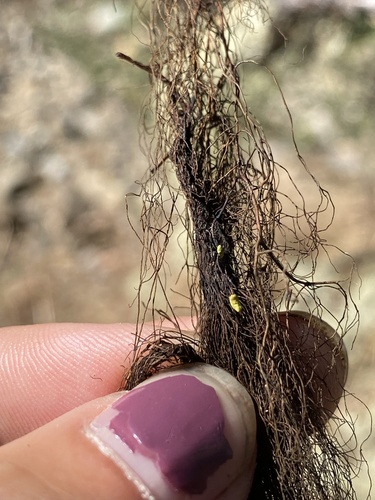
Horsehair Lichen
Dark brown to black hanging fruticose lichen that superficially resembles dark Usnea. The key difference: no central cord. When you pull a branch apart, it simply snaps or separates into fibers. There is no elastic white strand inside. Generally darker in color than Usnea.
No central cord • Dark brown to black
Mealy Pixie-Cup
Forms small trumpet-shaped cups (podetia) rising from a base of basal squamules. The inside and outside of the cups are covered in fine, granular soredia giving them a mealy, farinose texture. The cups appear powdery and slightly rough under magnification.
Cups sorediate (mealy) • Smooth
Pebbled Pixie-Cup
Very similar trumpet-shaped cups, but instead of soredia, the surfaces are covered in corticate squamules: tiny, flattened, scale-like structures with a proper cortex. Under a lens, the cups look rough and scaly rather than powdery. A classic soredia-vs-cortex distinction.
Cups squamulose (scaly) • Corticate
Hooded Rosette Lichen
Small gray-white foliose lichen with ascending lobe tips. The soralia are hood-shaped (helmet-shaped): the lobe tip curls over to form a little hood with soredia produced on the inner, protected surface. Cilia present along lobe margins.
Hood-shaped soralia • Tips curl over
Resembles P. adscendens
Very similar gray-white foliose lichen, but the soralia are lip-shaped rather than hooded. The lobe tips bend back slightly to expose soredia on an open, lip-like surface rather than enclosing them in a hood. Cilia also present. Requires a hand lens to separate reliably from P. adscendens.
Lip-shaped soralia • Tips bend back
Oakmoss
Strap-shaped fruticose lichen with distinct upper and lower surfaces. The upper surface is gray-green while the underside is conspicuously white. This two-toned appearance is the quickest way to recognize Evernia. Used extensively in the perfume industry.
White underside • Two-toned
Farinose Cartilage Lichen
Also strap-shaped and fruticose, but the same color on both sides: a pale yellowish-green throughout. No distinct upper/lower differentiation. Often bears marginal or laminal soredia along the branches. Thinner and more delicate than Evernia.
Same color both sides • Uniform