Photos
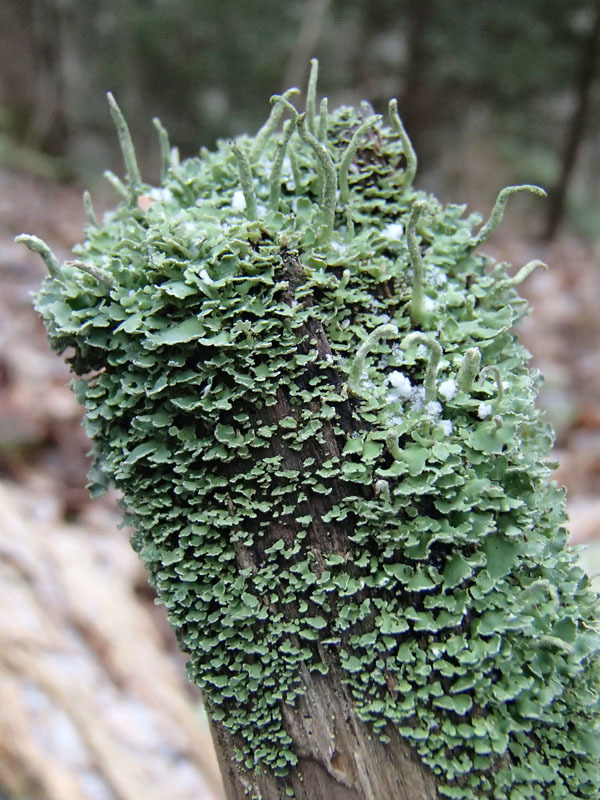
Photos by yakfur via iNaturalist (CC licensed)
Overview
Slender, pointed podetia (stalks) 1–3.5 cm tall rising from a mat of small basal squamules, Cladonia coniocraea is a ubiquitous Cladonia of rotting wood and tree bases. The podetia are unbranched, often curved, and taper to a fine point; the base keeps its cortex while the rest is covered in powdery (farinose) soredia.
Found on rotting logs, stumps and the bases of trees, mostly on acid bark and wood, and in towns as well as woods. Unlike the cup-bearing Cladonia species, its podetia are usually pointed, at most ending in tiny, narrow cups barely wider than the stalk.
It is often overlooked due to its small size and dull grey-green colour.
Identification
- Slender podetia 1–3.5 cm tall, unbranched, often curved, tapering to a point; robust ones may end in a tiny cup 1–3 mm long, barely wider than the stalk.
- Base corticate; the rest covered in fine, farinose (powdery) soredia.
- Grey-green to mint-green, greener when wet; basal squamules dull green above and pale below, usually persistent.
- Usually on rotting wood or bark at the base of trees, less often on peaty soil.
- C. fimbriata has regular goblet-shaped cups that widen abruptly from the stalk. Robust cupped forms were once called C. ochrochlora, but genetic work has not supported separating the two.
- Spot tests: P+ red (fumarprotocetraric acid), K−.
Ecology & Habitat
Grows chiefly on acid bark and rotting wood, on stumps, fallen logs and tree bases, and less often on peaty heathland soils. It tolerates sulphur dioxide pollution but is less tolerant of nutrient enrichment.
Fun Facts
It is one of the commonest Cladonia on rotting wood and tree bases; the British Lichen Society calls it ubiquitous.
Its brown apothecia are rare, but very mature plants that form narrow cups at the tips can bear them.
Distribution
Widespread in Europe and North America; throughout Britain and Ireland