Photos
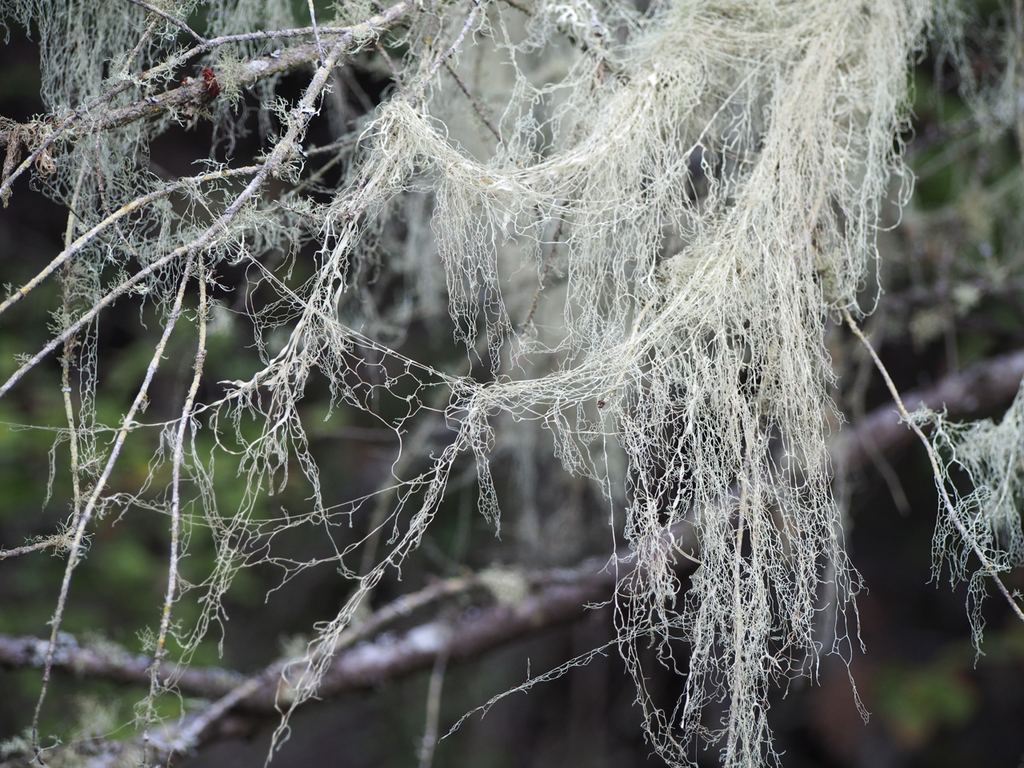
Photos by Wendy Feltham via iNaturalist (CC licensed)
Overview
Long, lace-like, pale yellowish-green to greyish-green strands hanging in curtains from branches, Ramalina menziesii is the state lichen of California and one of the most striking lichens in North America. It can grow up to about 1 metre long.
The flattened thallus is perforated into a net-like (reticulate) mesh that is unlike any other lichen in North America. The net is thick in sunny sites and thin, almost thread-like, in foggy ones. It takes all its water from rain, dew, fog and water vapour, and it is especially abundant where fog is frequent.
It is the most conspicuous lichen in California's coastal foothill oak woodlands, where it can make up most of the lichen growth on the trees.
Identification
- Long (up to about 1 m), pendant, pale yellowish-green strands hanging from branches and twigs.
- Thallus flattened and perforated into a distinctive net-like (reticulate) mesh, unlike any other North American lichen.
- The mesh is coarser in sunny sites and finer in foggy ones.
- Beard lichens (Usnea) also hang in clumps in its range but have round branches with a tough, elastic central cord. In the north, witch's hair (Alectoria) can look similar from a distance.
Ecology & Habitat
Found from shrubs and cacti in the coastal fog deserts of Baja California, through coast live oak, tan oak, California laurel, red alder and willow on the California coast and valley, blue and coast live oak savannas inland, to Sitka spruce and western hemlock forests in the Pacific Northwest. In blue oak woodland the canopy lichens, mostly lace lichen, trap extra nitrogen and phosphorus from the air. It is an important food for deer in the Coast Range, and birds use it as nest material.
Fun Facts
In 2015 it became the official state lichen of California, making California the first US state to recognise a lichen as a state symbol. The law took effect on 1 January 2016.
In one central California blue oak woodland, lichens averaged 3.8 kg per tree, about 590 kg per hectare, and lace lichen made up 78% of that.
Because it soaks up fog, it also picks up what the fog carries: it has been found accumulating methylmercury from coastal fog, which then passes to the deer that eat it.
It is named after Archibald Menzies (1754–1842), the Scottish naval surgeon and naturalist who collected it at Monterey, California. His specimen sat undescribed for more than half a century until Thomas Taylor named it in 1847.
Distribution
Pacific coast of North America, from southern Alaska to central Baja California
Sources
- California Legislature: AB 1528 (2015), enrolled text naming lace lichen the state lichen
- California Lichen Society: Lace lichen (Ramalina menziesii)
- Knops, Nash & Schlesinger (1997) The influence of epiphytic lichens on the nutrient cycling of a blue oak woodland, USDA Forest Service PSW-GTR-160
- Galloway (1995) The extra-European lichen collections of Archibald Menzies, Edinburgh Journal of Botany 52
- Wikipedia: Ramalina menziesii