Updated October 2026: corrected which layer gives the K+ yellow reaction.
Photos
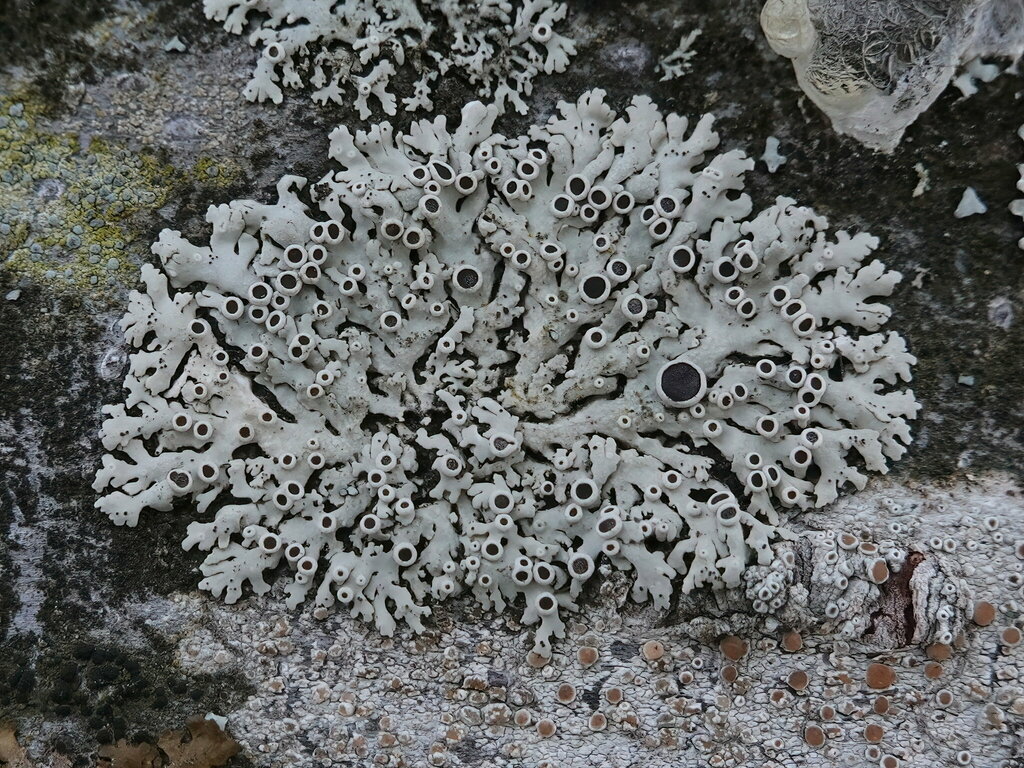
Photos by Hans Ritter via iNaturalist (CC licensed)
Overview
Pale grey to whitish with narrow, radiating lobes forming neat star-shaped rosettes, Physcia stellaris is a small but common lichen on the bark of deciduous trees and shrubs. It usually carries many apothecia with black discs, sometimes dusted white, each ringed by a rim the same pale grey as the thallus.
Unlike the sorediate Physcia species, P. stellaris has no soredia or isidia and reproduces sexually via its apothecia. The undersurface is white to pale brown with simple, pale rhizines.
One of several Physcia species common on urban trees, it grows in the same kinds of places as P. adscendens.
Identification
- Small, neat rosettes (2–5 cm) with narrow, radiating lobes about 0.5–1.5 mm wide.
- Pale grey to whitish upper surface; white to pale brown underside with simple, pale rhizines.
- Apothecia common, with black discs (sometimes white-pruinose) and a smooth thalline rim the colour of the thallus.
- No soredia (distinguishes it from P. adscendens and P. tenella).
- Cortex K+ yellow (atranorin); medulla K−.
- Chief look-alike: P. aipolia, which is usually more white-spotted on the upper surface and has a K+ yellow medulla.
Ecology & Habitat
Common on well-lit bark of deciduous trees, often isolated trees in towns, parks and along roads, and less often on conifers. It also grows on twigs and fallen wood and occasionally on rock. In Italy it is most common in the mountains, in and above the beech belt.
Fun Facts
The "stellaris" name means star-like, referring to the neat radiating pattern of its lobes that makes each thallus look like a tiny grey star on the bark.
Unlike its sorediate neighbours P. adscendens and P. tenella, it reproduces by sexual spores from its apothecia. Plenty of other lichens do the same, including P. aipolia and Xanthoria parietina.
It may be more than one species: unpublished DNA results reported by Lichens of Alberta suggest that what is called P. stellaris in Alberta is at least one undescribed species.
Distribution
Cosmopolitan; mainly cool-temperate to southern boreal