Updated October 2026: corrected the spot tests and surface description, and replaced the first photo.
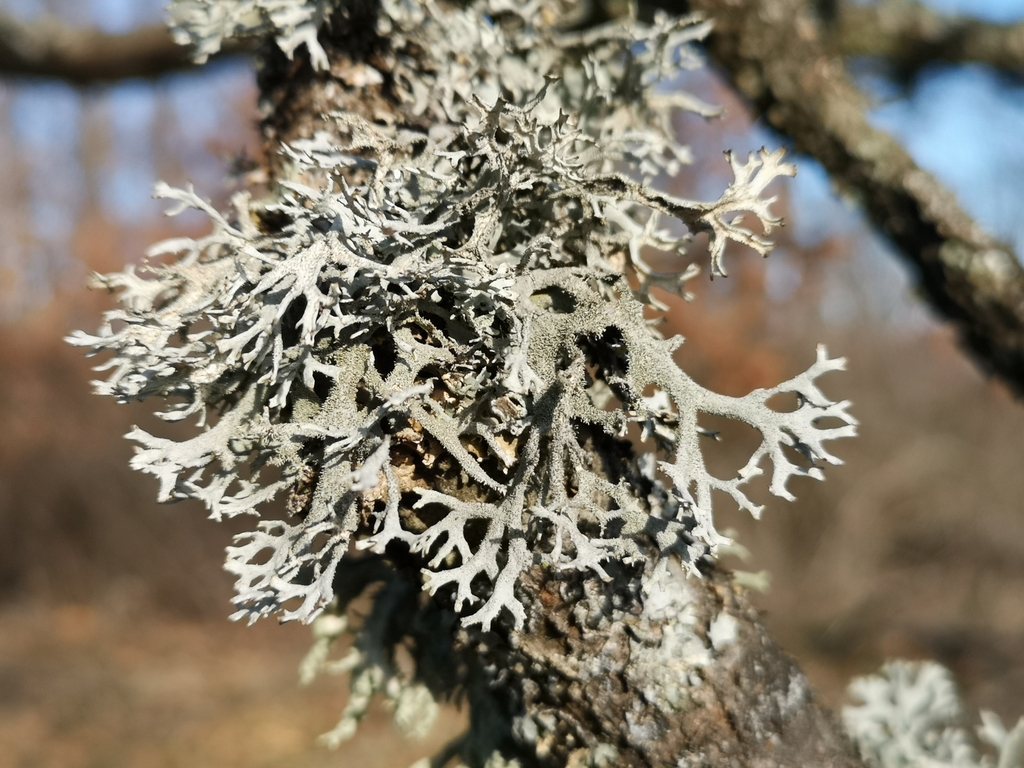
Overview
Gray to brownish-gray above and dark below, Pseudevernia furfuracea forms irregular, branching tufts 3–10 cm long on conifer bark in montane forests. The contrast between the pale upper surface and the grey-black (often mottled) underside is its most distinctive feature.
The upper surface bears tiny isidia, giving it a rough, furfuraceous (scurfy) texture that inspired its species name. It is one of the most common and conspicuous epiphytic lichens in European mountain forests.
Like true oakmoss (Evernia prunastri), it has been used in perfumery, though less extensively. It contains atranorin and physodic acid, giving it a distinct chemical profile.
Identification
- Gray to brownish-gray above; underside grey-black, or mottled black and brownish-white or pinkish.
- Irregularly branching tufts (3–10 cm) on bark; branches strap-shaped and flattened.
- Upper surface usually covered in tiny isidia (furfuraceous, scurfy texture); no rhizines.
- Cross-section shows white medulla between gray cortex above and black cortex below.
- Cortex K+ yellow (atranorin); medulla C− in var. furfuracea (physodic acid) but C+ red in var. ceratea (olivetoric acid).
Ecology & Habitat
Common on conifer bark in montane forests, and abundant in the mountain forests of Europe. It is an acidophile: the British Lichen Society describes it as most common on slightly acid, polluted sites. It tolerates acid (SO₂) pollution but is harmed by ammonia, and it is widely used in transplant biomonitoring of metals.
Fun Facts
Among strap-like, tufted lichens, a dark underside is a good clue to this species, though plenty of other lichens, such as Hypogymnia physodes and some Parmelia species, are also black below.
It has been harvested for use in perfumery alongside oakmoss, though its scent profile is more woody and less sweet. The fragrance industry calls it "tree moss absolute."
The ancient Egyptians imported it. It has been found in an 18th-Dynasty vase and packed into the body cavities of mummies, though whether it was used to help preserve the body or for its scent is unclear.
Unlike most lichens, it does not mind acid pollution. In south-east England it has actually declined as sulphur dioxide pollution has fallen.
Distribution
Europe, Asia and North Africa, mostly at higher elevations, with only very occasional reports from Mexico, Central America, Bolivia and Uganda. In North America it is replaced by P. consocians, P. intensa and P. cladonia