Updated October 2026: corrected the compounds behind the medulla spot test.
Photos
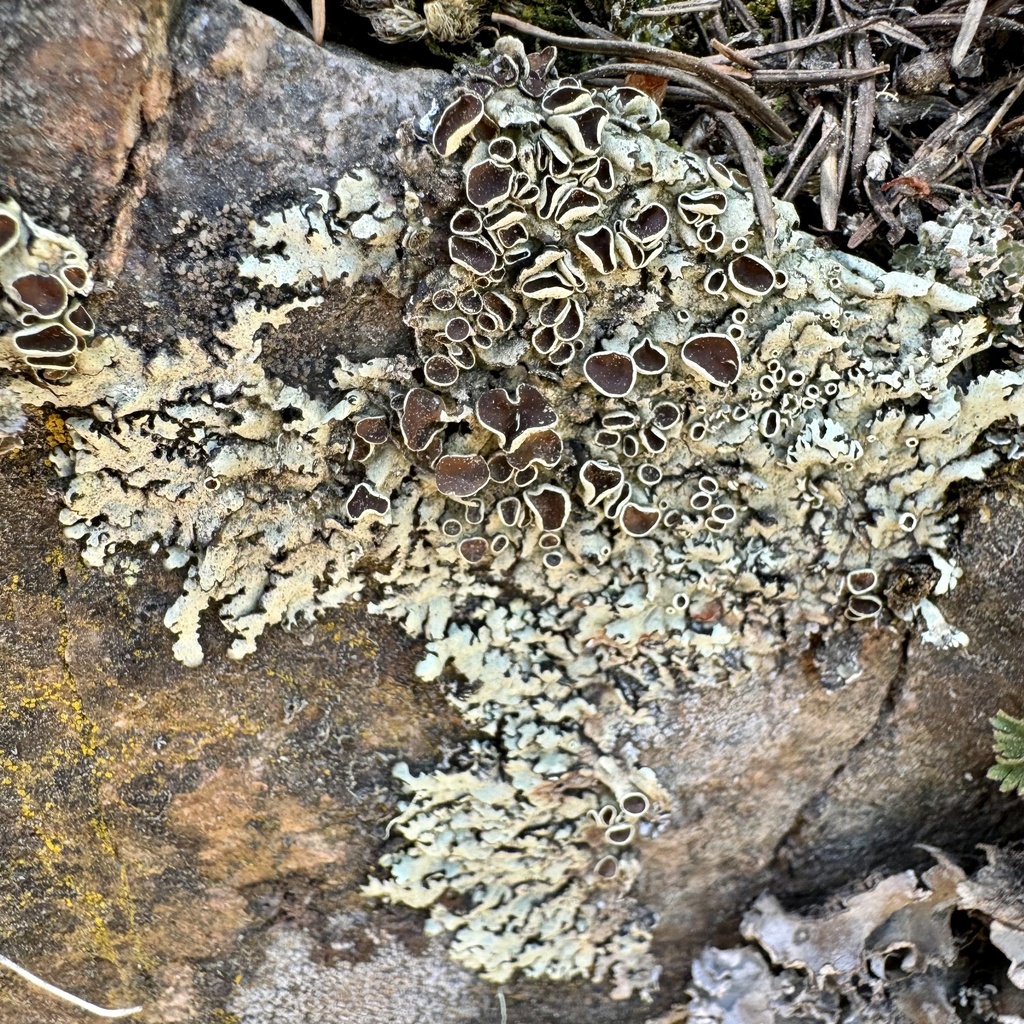
Photos by Karen Guin via iNaturalist (CC licensed)
Overview
Yellow-green to olive-green rosettes tightly appressed to rock surfaces, Xanthoparmelia cumberlandia is one of the most common foliose rock lichens in eastern North America. It forms neat, circular thalli 3–15 cm in diameter on exposed boulders and outcrops.
The upper surface has neither isidia nor soredia, apothecia are common, and its lobes are closely attached to the rock surface. The undersurface is pale tan to dark brown with simple rhizines.
The genus Xanthoparmelia is one of the largest lichen genera in the world, with over 800 species, mostly on rock or soil.
Identification
- Yellow-green to olive-green rosettes closely appressed to rock.
- Upper surface without isidia or soredia; apothecia common. (The isidiate look-alike with the same chemistry is X. conspersa.)
- Lobes 2–5 mm wide, forming neat circular thalli.
- Underside pale tan to brown (not black); simple rhizines.
- Always on rock, never on bark. Medulla K+ yellow (or slowly orange), P+ orange (stictic acid). A K+ red medulla points instead to X. lineola (salazinic acid).
Ecology & Habitat
Dominates exposed, sun-lit siliceous rock surfaces. One of the first foliose lichens to colonize bare rock in eastern North America. Tolerates full sun, extreme heat, and periodic drought. Often found with crustose rock lichens and Umbilicaria species.
Fun Facts
The genus Xanthoparmelia contains over 800 species worldwide, making it one of the largest lichen genera. Most grow on rock or soil.
It copes with baking summer sun on bare rock by drying out and shutting down photosynthesis until conditions improve.
It is often confused with species in the closely related genus Flavoparmelia. Substrate will not separate them, because the rock greenshield (Flavoparmelia baltimorensis) grows on rock too. Check the underside instead: black with rhizines in Flavoparmelia, brown in X. cumberlandia. Lobe width also helps.
Distribution
Widespread across North America (absent from deserts and open plains); also reported from Europe and South America