Overview
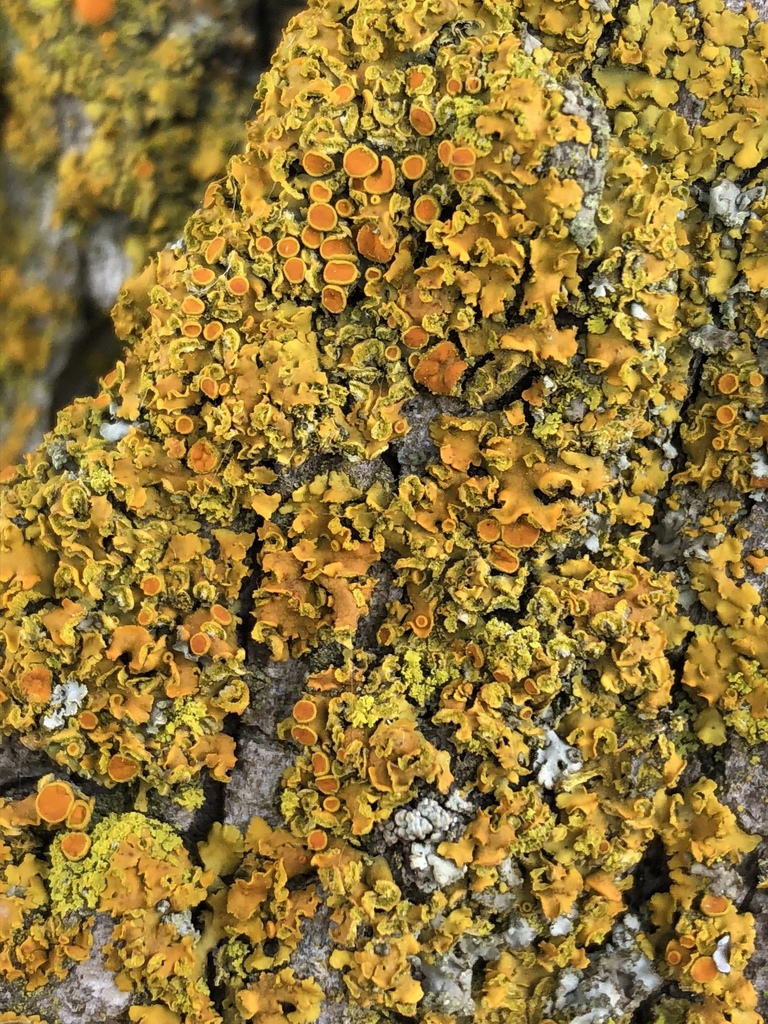
Small, yellow-orange to dark orange, with distinctive hood-shaped soralia at the lobe tips, Xanthomendoza fallax is a common lichen on broadleaved trees. It forms small rosettes up to about 3 cm across, which can merge into large colonies.
The soralia are diagnostic: the lobe tip splits between its upper and lower surfaces and opens into a crescent-shaped hood, or "bird's nest", filled with greenish-yellow powdery soredia. This feature distinguishes it from Xanthoria parietina, which has no soredia.
One of several small orange lichens on town trees, it is described by Lichens of Alberta as a ubiquitous and abundant epiphyte across all urban habitats.
Identification
- Small (to about 3 cm), yellow-orange to dark orange rosettes or merging colonies on bark.
- Hood-shaped or crescent-shaped soralia at the lobe tips, formed where the lobe splits between its upper and lower surfaces; soredia greenish-yellow.
- Smaller than Xanthoria parietina, which lacks soredia.
- Apothecia are often present, especially in urban areas, so fertile thalli do not rule it out.
- Cortex K+ purple (anthraquinones such as parietin); medulla white, spot tests negative.
- Look-alike: X. fulva has soralia below the lobe tips or lip-shaped, sparser rhizines and usually narrower lobes.
Ecology & Habitat
Grows on bark and fallen wood. In Alberta it is abundant on urban trees and commonest in the parkland and southern boreal regions. In Norway it has been recorded on sun-exposed broadleaved trees such as maple, birch, beech, ash, poplar, lime and elm. In the Czech Republic, by contrast, it is treated as mainly a rock species of calcium-enriched, dusty siliceous rocks, and older bark records there are thought to belong to the closely related X. huculica.
Fun Facts
The species name "fallax" means deceptive, fitting for one of several small orange lichens that are easy to mix up.
Its name keeps moving: first described as Physcia fallax, it has also been Xanthoria fallax, and some current databases list it as Oxneria fallax.
Distribution
Widespread; recorded across North America, Europe and Asia (to the Himalaya)