Photos
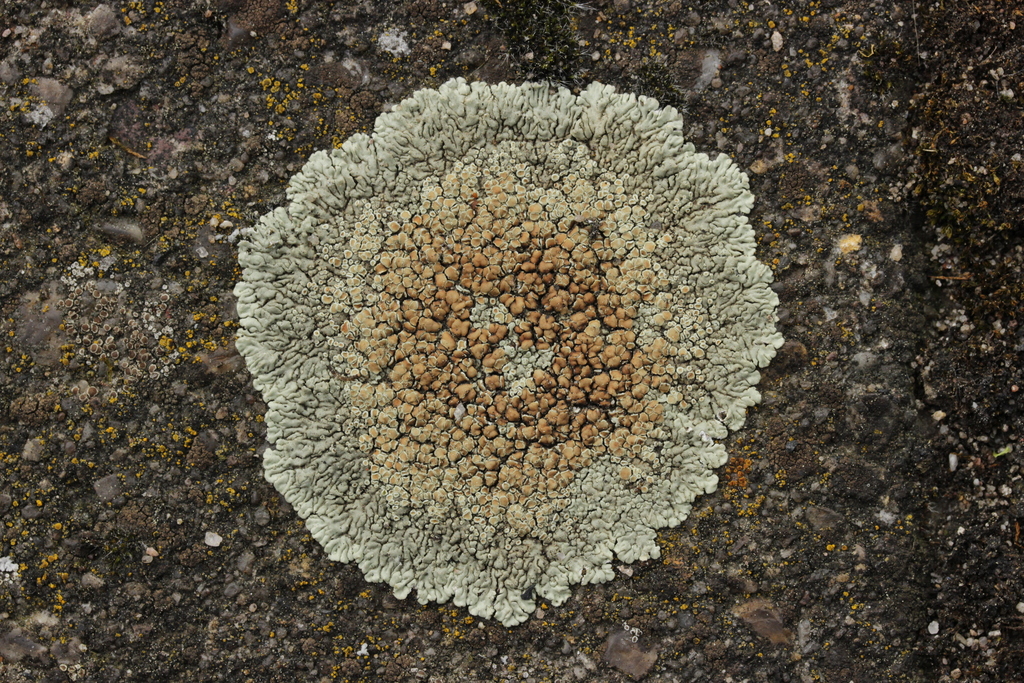
Photos by Björn Sothmann via iNaturalist (CC licensed)
Overview
Pale yellow-green to yellow-brown rosettes, darker towards the centre, with neat lobed margins and crowded apothecia in the middle: Protoparmeliopsis muralis is one of the commonest lichens on human-made surfaces. Rosettes are usually a few centimetres across but can reach 10 cm.
Despite its crustose growth form, the narrow marginal lobes are clearly defined and give it a rosette appearance. The yellow-brown to red-brown apothecia, each with a well-developed pale rim, often crowd the centre of the thallus.
Formerly classified as Lecanora muralis (a name still widely used), it is tolerant of air pollution and grows on everything from concrete and tarmac to tiles, making it one of the most familiar urban lichens.
Identification
- Forms neat circular rosettes with distinct narrow lobes (about 0.5–0.8 mm wide) at the margin.
- Pale green-yellow to yellow-brown, shiny to slightly pruinose, darker in the centre.
- Apothecia densely crowded in the centre; discs yellow-brown to red-brown, with a well-developed, often pruinose thalline margin.
- Usually on stone, concrete, tarmac or tiles; occasionally on nutrient-rich bark or wood.
- Lobes usually closely pressed to the surface. The very rare P. achariana has more loosely attached, convex lobes.
- Thallus C−, K−, KC+ pale yellow (usnic acid).
Ecology & Habitat
It grows in two very different settings: nutrient-enriched bird-perch rocks and calcareous rocks in the countryside, and a wide range of man-made surfaces in towns, including concrete, asbestos-cement, tarmac, paving slabs and tiles. It is air-pollution tolerant, and van Herk's Dutch index of ammonia pollution counts it as a nitrophyte. The British Lichen Society notes that urban populations may be a different ecotype from those on upland bird-perch rocks.
Fun Facts
It is extremely common in lowland Britain and Ireland. If you have walked down a paved street there, you have probably walked past it.
Long known as Lecanora muralis, it is placed by the British Lichen Society in Protoparmeliopsis, a genus Choisy described in 1929.
It is popularly called the "chewing-gum lichen": trampled patches on urban pavements look like dropped gum.
On zinc and lead smelter slag in southern Poland it has been found to hyperaccumulate heavy metals, building up higher concentrations in its thallus than in the slag it grows on.
Distribution
Worldwide: Europe, Asia, North and South America, Africa and Australasia
Sources
- British Lichen Society: Protoparmeliopsis muralis species account
- Wikipedia: Lecanora muralis
- Rola, Osyczka & Kafel (2016) Heavy metal accumulation strategies of epilithic lichens on post-smelting wastes, Arch. Environ. Contam. Toxicol. 70
- British Lichen Society Bulletin 91 (2002): van Herk's nitrophytes and acidophytes (Table 1)